Louise, Opéra de Lyon
Elsa Dreisig, que l’on attendait pour cette Louise applaudie au Festival d’Aix l’été dernier, était souffrante lors de la première
lyonnaise. C’est la soprano Gabrielle Philiponet qui la remplace
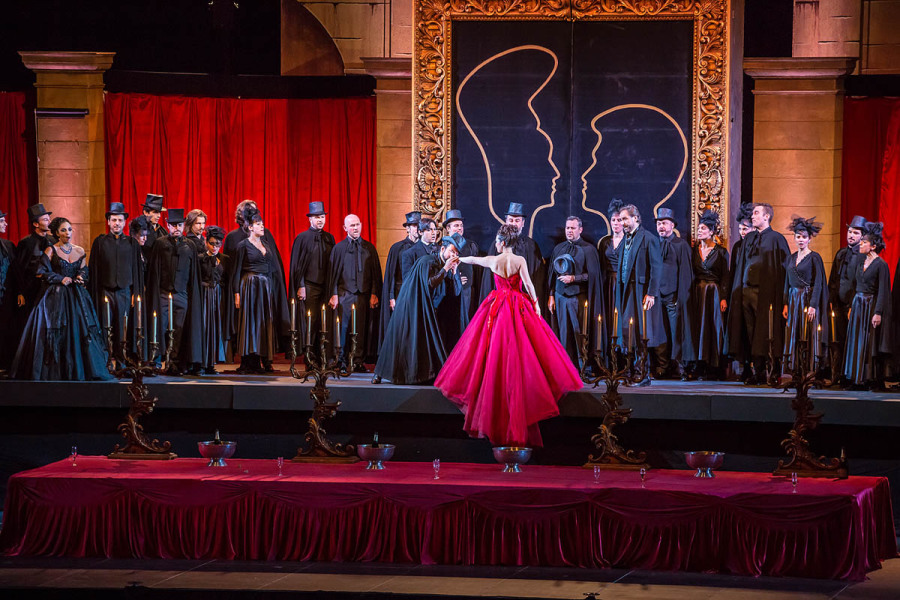
au pied levé, au sens propre du terme tant son personnage semble sans cesse en partance : son agilité sur scène, dans une mise en scène physiquement très exigeante, est remarquable tout autant
que son jeu dramatique poignant. Donnant au rôle toute l’humanité voulue par Gustave Charpentier, sa fragilité naïve, mais aussi l’impétuosité de son amour et l’affirmation de sa volonté de liberté,
elle forme avec le robuste et fringant Julien d’Adam Smith un couple à
la fois paradoxal et complémentaire – lui extraverti, assuré de leur bonheur futur, […] ; elle, au chant tout en inflexions subtiles, délicates, tout d’abord effarouchée et menue, se recroquevillant
sur un banc ou se jetant dans ses bras. Un couple convaincant aussi par le jeu de la réciprocité et par l’évolution de Louise au cours de l’opéra, dans son statut de partenaire amoureuse inversant
l’ordre convenu du désir à la suite de son grand air « Depuis le jour », épreuve parfaitement réussie pour franchir le seuil de l’acte III. On peut savoir gré à Gabrielle Philiponet, qui
doit chanter Mimi dans La Bohème à Clermont-Ferrand et à Massy au mois de mars (voir également ses réponses au Questionnaire de Proust de ce mois de janvier 2026), d’avoir ainsi, dans une parfaite
osmose avec ses partenaires, permis à cette représentation d’avoir lieu.
Elsa Dreisig, who was eagerly awaited for the role of Louise, which was applauded at the Aix Festival last summer, was unwell during the Lyon premiere. Soprano Gabrielle Philiponet stepped in at the last minute, quite literally, as her character seemed constantly on the verge of leaving: her agility on stage, in a physically demanding production, was remarkable, as was her poignant dramatic performance. Giving the role all the humanity intended by Gustave Charpentier, its naive fragility, but also the impetuosity of its love and the assertion of its will to freedom, she forms with Adam Smith's robust and dashing Julien a couple that is both paradoxical and complementary – he, extroverted, certain of their future happiness,[…] ; she, with her singing full of subtle, delicate inflections, initially timid and petite, cowering on a bench or throwing herself into his arms. A convincing couple also through the interplay of reciprocity and through Louise's evolution throughout the opera, in her role as a lover who reverses the conventional order of desire following her great aria "Depuis le jour," a test perfectly met to cross the threshold of Act III. We can thank Gabrielle Philiponet, who is to sing Mimi in La Bohème in Clermont-Ferrand and Massy in March (see also her answers to the Proust Questionnaire of this month of January 2026), for having thus, in perfect harmony with her partners, allowed this performance to take place.
Fabrice Malkani, Forum Opéra
La révélation d’une nouvelle Louise
Quant au rôle-titre, Elsa Dreisig n’a hélas pas pu l’assurer, mais l’Opéra de Lyon a réussi le miracle de lui trouver une remplaçante in extremis : alors qu’elle était encore Cupidon d’Orphée aux enfers à Tours quelques jours avant, Gabrielle Philipponet fait mieux que sauver le spectacle, puisqu’elle a su à merveille s’approprier scéniquement et vocalement cette jeune femme un peu godiche que devient ici Louise, poursuivant avec brio un parcours dans l’opéra français où elle a notamment été une mémorable Marguerite.
Puisse Louise revenir enfin au répertoire, puisque l’œuvre dispose désormais non pas d’une, mais de deux titulaires possibles.
The Revelation of a New Louise
As for the title role, Elsa Dreisig was unfortunately unable to perform it, but the Lyon Opera miraculously found a last-minute replacement: Gabrielle Philipponet, who had just been singing Cupid in Orphée aux Enfers in Tours a few days earlier, did more than save the show. She brilliantly embodied, both scenically and vocally, the somewhat naive young woman that Louise becomes here, continuing her impressive career in French opera, where she was notably a memorable Marguerite.
May Louise finally return to the repertoire, since the work now has not one, but two possible interpreters.
Laurent Bury, Classica
Actualité
Interviews :
Questionnaire de Proust Lyrique
Lille.fr par Valérie Pfahl
Opéra Online par Emmanuel Andieu
 Version imprimable