Voyage d'Automne, Capitole Toulouse
Il s’agit là, dramatiquement et musicalement d’un des sommets de la pièce. C’est Gabrielle Philiponet qui campe cette Songeuse et qui porte ce rôle avec une force indescriptible. Elle happe notre regard dès sa première apparition avant que la voix, parfaitement placée, jamais mise en difficulté, y compris par la langue allemande, ne s’empare de nous. Ses trois apparitions (la première est muette, la deuxième est limitée à la première strophe du poème, qu’elle reprendra intégralement dans la grande scène du III) nous montrent une femme tout de blanc vêtue, comme planant au-dessus de ce qu’on devine être le champ des ruines de notre humanité.
This is, dramatically and musically, one of the highlights of the play. It is Gabrielle Philiponet who plays this Dreamer and who carries this role with an indescribable force. She grabs our attention from her first appearance before the voice, perfectly placed, never put in difficulty, including by the German language, takes hold of us. Her three appearances (the first is silent, the second is limited to the first stanza of the poem, which she will take up in full in the great scene of III) show us a woman dressed all in white, as if hovering above what we guess is the field of the ruins of our humanity.
Thierry Verger, Forum Opéra
Ils s'unissent encore pour faire apparaître, tel un rêve éveillé, la seule voix féminine de cet opéra, Gabrielle Philiponet (La Songeuse), délivrant avec sa voix de soprano la poésie de Gertrude Kolmar, gazée à Auschwitz en 1943. Le lied déployé par la chanteuse, tout comme ses deux autres interventions, se révèle un véritable moment de respiration dans cette ambiance étouffante, telle une vive lumière au fond d'un long tunnel. Sur des échasses, la soprano maintient avec puissance et assise, une humanité hagarde mais vivante.
They unite again to make appear, like a waking dream, the only female voice of this opera, Gabrielle Philiponet (La Songeuse), delivering with her soprano voice the poetry of Gertrude Kolmar, gassed at Auschwitz in 1943. The lied deployed by the singer, just like her two other interventions, reveals itself to be a real moment of respite in this stifling atmosphere, like a bright light at the end of a long tunnel. On stilts, the soprano maintains with power and seated, a haggard but living humanity.
Charlotte Saulneron, Resmusica
Enfin la voix cristalline, longue, très homogène sur la longueur du registre (avec de solides graves) de Gabrielle Philiponet permet de donner au poème chanté tout son impact poétique rempli d’émotion.
Finally, the crystalline, long, very homogeneous voice over the length of the register (with solid low notes) of Gabrielle Philiponet allows the sung poem to be given all its poetic impact filled with emotion.
Didier Roumilhac, Résonances Lyrique
une seule femme, la soprano Gabrielle Philiponet, qui interprète La Songeuse. De sa voix puissante et incantatoire elle déclame, presque en parlé-chanté, des textes de la poétesse juive Gertrude Kolmar, assassinée à Auschwitz. Figure spectrale mais profondément humaine, elle « élève la voix de la vie, faible mais éternel scintillement dans la nuit et le brouillard de ce voyage d’automne », pour reprendre les mots de Dorian Astor.
only one woman, the soprano Gabrielle Philiponet, who sings La Songeuse. With her powerful and incantatory voice she declaims, almost in spoken-sung, texts by the Jewish poet Gertrude Kolmar, murdered at Auschwitz. A spectral but profoundly human figure, she “raises the voice of life, a weak but eternal scintillation in the night and fog of this autumn journey,” to borrow the words of Dorian Astor
Claire de Castellane, Crescendo Magazine
Enfin, parce qu’elle est la seule respiration humaine dans ce sombre cloaque, parce qu’elle fait passer dans son chant toute la fragilité et toute la dignité d’un idéal sacrifié, comment ne pas retenir les moments inoubliables que nous offre la Songeuse de la soprano Gabrielle Philiponet, tache de blancheur dans cette jungle vert-de-gris ?
Finally, because she is the only human breath in this dark cesspool, because she conveys in her song all the fragility and all the dignity of a sacrificed ideal, how can we not remember the unforgettable moments offered to us by the Songeuse of the soprano Gabrielle Philiponet, a spot of whiteness in this verdigris jungle?
Pierre Cadars, Opéra Magazine
Seule femme en scène, Gabrielle Philiponet habite magnifiquement la Songeuse éponyme du poème de Gertrud Kolmar, donnant voix et réalité à ces martyrs que le quintette français se refuse à entendre.
The only woman on stage, Gabrielle Philiponet magnificently inhabits the eponymous Songeuse of Gertrud Kolmar's poem, giving voice and reality to these martyrs that the French quintet refuses to hear.
Anne Ibos-Augé, Diapason
Illuminée par un halo qui dilate le plateau, auréolée d’un disque céleste, dans une robe immaculée, au sens fort exempte de toute souillure morale, Gabrielle Philiponet incarne ce personnage allégorique avec une dignité et un lyrisme salvateurs […] Elle est aussi à la fin de chaque acte, dans la représentation d’une figure de la Poésie qui vainc la mort et l’oubli. […] Faut-il rappeler que Gabrielle Philiponet, soprano séraphique offre à la lumineuse Songeuse la clarté et la sérénité nécessaires pour ne pas sombrer dans le désespoir ?
Illuminated by a halo that expands the stage, surrounded by a celestial disk, in an immaculate dress, in the strong sense free from any moral stain, Gabrielle Philiponet embodies this allegorical character with a dignity and a saving lyricism […] She is also at the end of each act, in the representation of a figure of Poetry who conquers death and oblivion. […] Should we recall that Gabrielle Philiponet, seraphic soprano, offers the luminous Songeuse the clarity and serenity necessary to avoid sinking into despair?
Jean Jordy, Revue Commune
Les trois apparitions de la Songeuse/Gabrielle Philiponet sont d’un autre temps et d’un autre monde. Son air du tableau XI renvoie à la mélodie infinie (quoique microtonale) d’un Wagner. Le soprano de Gabrielle Philiponet en a l’ampleur et le timbre dramatique faisant de cet instant unique, magnifié par un orchestre flamboyant, une des plus belles pages de l’opéra.
The three appearances of the Songeuse/Gabrielle Philiponet are from another time and another world. Her aria in tableau XI refers to the infinite (albeit microtonal) melody of a Wagner. Gabrielle Philiponet's soprano has the breadth and dramatic timbre, making this unique moment, magnified by a flamboyant orchestra, one of the most beautiful pages of the opera.
Michele Tosi, singulars.fr
Mais l’idée miraculeuse est celle d’une triple apparition. Une femme. Longue robe blanche, voiles ophéliens, la Songeuse incarne, à la fin de chacun des trois actes, le spectre de la poétesse juive allemande Gertrud Kolmar (1894-1943), morte en déportation à Auschwitz, dont le poème, La Songeuse, servira de point d’orgue. La soprano Gabrielle Philiponet y déploie les trois strophes d’un Lied magnifique, dans la lignée de Brahms, Wagner ou Mahler, tandis que, sur le plateau, flotte un cercle lumineux. L’aube d’un monde d’après la malédiction, où l’anneau aurait rejoint les paisibles eaux du Vater Rhein.
But the miraculous idea is that of a triple apparition. A woman. Long white dress, Ophelian veils, the Songeuse embodies, at the end of each of the three acts, the ghost of the German Jewish poet Gertrud Kolmar (1894-1943), who died in deportation to Auschwitz, whose poem, La Songeuse, will serve as the climax. The soprano Gabrielle Philiponet deploys the three stanzas of a magnificent Lied, in the tradition of Brahms, Wagner or Mahler, while, on the stage, floats a luminous circle. The dawn of a world after the curse, where the ring would have joined the peaceful waters of the Vater Rhein.
Marie-Aude Roux, Le Monde
Enfin, on n’est pas près d’oublier les apparitions de la soprano Gabrielle Philiponet qui, juchée sur d’invisibles échasses et flottant dans ses voiles immaculés, chante en allemand le lied de La Songeuse, bouleversante voix rescapée de la catastrophe.
Finally, we are not about to forget the appearances of soprano Gabrielle Philiponet who, perched on invisible stilts and floating in her immaculate veils, sings in German the lied of La Songeuse, a moving voice that survived the catastrophe.
Noël Tinazzi, webtheatre
Seule voix féminine du plateau, la soprano Gabrielle Philiponet revêt les voiles vaporeux de La Songeuse, déployant une ligne de chant et un timbre de toute beauté.
The only female voice on the panel, soprano Gabrielle Philiponet dons the vaporous veils of La Songeuse, deploying a singing line and timbre of great beauty.
Robert Peynavayre, Classictoulouse
Il fallait des espaces de respiration dans cet atmosphère tragique d’outre-tombe inhumaine. Le rôle de La Songeuse apparaît trois fois et plus particulièrement en ce tableau 11 avec un très très beau chant conclusif interprété par Gabrielle Philiponet.
There needed to be moments of respite in this tragic, inhuman, otherworldly atmosphere. The role of La Songeuse appears three times, most notably in scene 11, with a truly beautiful concluding song performed by Gabrielle Philiponet.
Michel Grialou, Culture31
La soprano Gabrielle Philiponet apparaît par trois fois dans le rôle de la Songeuse : d’abord, sans parole,
lors d’un interlude (tableau IV), portée par l’orchestre ; puis, au 2e acte, dont elle colore la conclusion de mystère en énonçant les premiers vers d’un poème (« La Songeuse »)
de Gertrud Kolmar, poétesse morte en déportation à Auschwitz en 1943. À la fin du 3e acte, elle fera entendre l’intégralité du poème dans le plus beau moment mélodique de
ce Voyage d’automne, un
long liedsymphonique qui nous
rappelle rétrospectivement, que nous n’aurons entendu, de la bouche des « grands écrivains » (auto)proclamés qui étaient du voyage, que quelques aphorismes, au pire triviaux, au mieux
précieux.
Les apparitions de la Songeuse suspendent l’action, triomphent de la conversation en musique.
Soprano Gabrielle Philiponet appears three times in the role of La Songeuse : first, without words, during an interlude (scene IV), accompanied by the orchestra; then, in Act II, where she imbues the conclusion with mystery by reciting the opening lines of a poem ("The Dreamer") by Gertrud Kolmar, a poet who died in deportation to Auschwitz in 1943. At the end of Act III, she performs the entire poem in the most beautiful melodic moment of this Autumn Journey, a long symphonic lied that reminds us, in retrospect, that we heard only a few aphorisms from the mouths of the (self-)proclaimed "great writers" who were on the journey—at worst, trivial, at best, precious. The Dreamer's appearances suspend the action, triumphing over the musical conversation.
Jean-Guillaume Lebrun, concertclassic.com
Au milieu de ce monde de brute, Gabrielle Philiponet est la seule femme de la distribution. Elle interprète la Songeuse, allégorie du massacre des juifs, spectrale et pourtant profondément humaine, condamnée à exister au milieu de personnages insupportables qui ne se supportent pas eux-mêmes, conscients de leur lâcheté.
In the midst of this brutal world, Gabrielle Philiponet is the only woman in the cast. She plays La Songeuse, an allegory of the massacre of the Jews, spectral yet profoundly human, condemned to exist amidst unbearable characters who cannot stand themselves, aware of their cowardice.
Jean-Luc Martinez, La Dépêche
La musique porte puissamment l’onirisme de l’œuvre, renforcée des visuels marqués et mis en abîme par le seul personnage véritablement fictionnel du spectacle: la Songeuse (Gabrielle Philiponet), apparaissant dans trois tableaux d’entractes avec sa traîne et sa longue robe blanche. Son premier tableau est captivant de suspens : elle est en scène pendant de longues minutes captivantes accompagnée par l’orchestre avant de clore l’acte I sans avoir dit un mot. Elle chante brièvement dans le deuxième, avant de finir par s’exprimer davantage dans son troisième et dernier tableau (juste avant l’épilogue), dominant la scène de 3 ou 4 mètres de haut.
The music powerfully conveys the dreamlike quality of the work, reinforced by striking visuals and the mise en abyme of the only truly fictional character in the performance: La Songeuse (Gabrielle Philiponet), who appears in three intermission scenes with her train and long white dress. Her first scene is captivating in its suspense: she is on stage for several enthralling minutes accompanied by the orchestra before concluding Act I without having uttered a word. She sings briefly in the second scene, before finally expressing herself more fully in her third and final scene (just before the epilogue), towering three or four meters above the stage.
Timothé Bougon, Classykeo
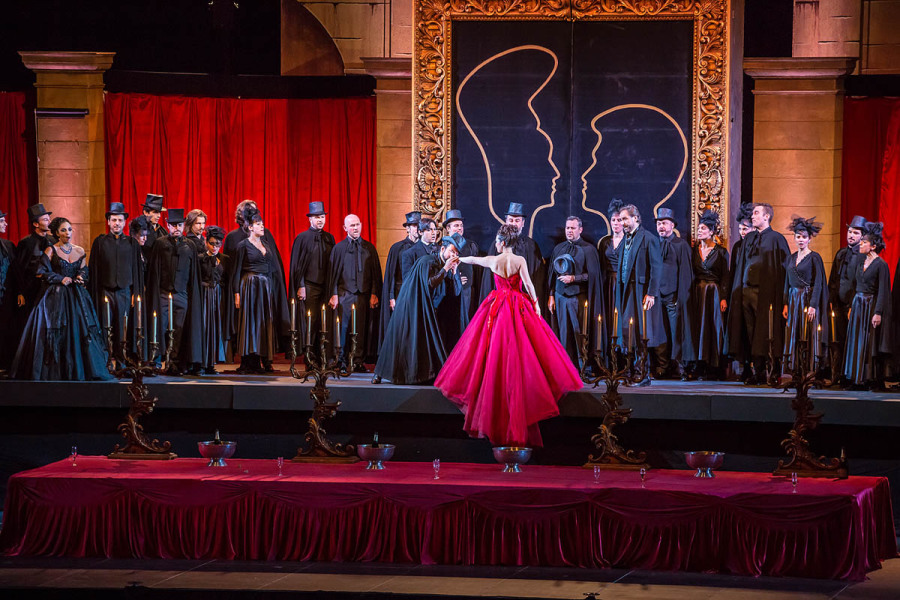
La Rondine, Metz
[…] la distribution réunie pour servir cette Rondine n’appelle elle aussi que les éloges, à commencer par Gabrielle
Philiponet dont certains Lorrains se souviennent encore de la Magda chantée à Nancy en 2012 sous la direction de José Cura. La retrouver dans le même rôle une dizaine d’années plus tard confirme
définitivement les affinités que cette belle artiste entretient avec l’hirondelle puccinienne. De Magda de Civry, la soprano albigeoise possède le timbre capiteux, le medium charnu, les aigus
diamantins et l’intelligence du caractère. Jamais en effet son personnage ne verse dans la caricature : coquette sans minauder, amoureuse sans mièvrerie, cette Magda convient idéalement à la
vocalità de Gabrielle Philiponet ainsi que le confirme l’aria « Chi il bel sogno di Doretta » délivré avec l’aplomb d’une artiste confirmée.
[…] the cast assembled to perform this Rondine also calls for nothing but praise, starting with Gabrielle Philiponet, whose Magda sung in Nancy in 2012 under the direction of José Cura is still remembered by some Lorrainers. Finding her in the same role ten years later definitively confirms the affinities that this beautiful artist has with the Puccini swallow. The soprano from Albi has Magda de Civry’s heady timbre, fleshy medium, diamond-like high notes and intelligence of character. Indeed, her character never falls into caricature: flirtatious without mincing, in love without being sentimental, this Magda is ideally suited to Gabrielle Philiponet’s vocalità, as confirmed by the aria “Chi il bel sogno di Doretta” delivered with the aplomb of a confirmed artist.
Nicolas Le Clerre, Première Loge
Gabrielle Philiponet rayonne en Magda. Dans le petit théâtre messin, l'ampleur et la rondeur de sa voix font merveille, et chacune de ses interventions est lestée de mélancolie. La soprano française a, manifestement, beaucoup travaillé son rôle; elle atteint à un lyrisme epanoui, au IlI, après avoir trouvé, au lI, les accents les plus poignants pour avouer devant son protecteur, le banquier Rambaldo […] qu'elle a rencontré l'amour.
Gabrielle Philiponet shines as Magda. In the small Metz theater, the breadth and richness of her voice work wonders, and each of her interventions is imbued with melancholy. The French soprano has clearly worked extensively on her role; she achieves a blossoming lyricism in Act III, after having found, in Act I, the most poignant accents to confess to her protector, the banker Rambaldo […] that she has found love.
Christian Wasselin, Opéra Magazine
Gabrielle Philiponet, straordinaria interprete di Magda, ha offerto una grande prova vocale e attoriale. La sua voce calda e avvolgente ha saputo esprimere tutta la gamma emotiva del personaggio: dal sogno di una vita diversa e spensierata, alla consapevolezza dolorosa che l’amore, per quanto autentico, può essere impossibile. Nel celebre "aria a quattro" del secondo atto, la sua presenza scenica ha dominato il palco, ma senza mai oscurare i suoi compagni.
Gabrielle Philiponet, interprète extraordinaire de Magda, a offert une performance vocale et scénique magistrale. Sa voix chaude et enveloppante a su exprimer toute la gamme des émotions de son personnage : du rêve d’une vie différente et insouciante à la douloureuse prise de conscience que l’amour, même authentique, peut être impossible. Dans le célèbre aria à quatre du deuxième acte, sa présence scénique a dominé la scène sans jamais éclipser ses partenaires.
Gabrielle Philiponet, an extraordinary interpreter of Magda, delivers a masterful vocal performance. Her warm, enveloping voice perfectly captured the full range of her character's emotions: from dreaming of a different, carefree life to the painful pang of awareness that love, even genuine love, can be impossible. In the famous quartet aria from the second act, her stage presence dominated without ever overshadowing her partners.
Giovanni Zambito Fattitaliani
Gabrielle Philiponet, quant à elle, rayonne vocalement et physiquement dans le rôle de Magda dont elle a à la fois l'aigu étincelant, le legato voluptueux et le pathos qui conduit son personnage à l'auto-sacrifice final. On se réjouit de voir cette artiste bien connue à Metz s'améliorer de saison en saison.
Gabrielle Philiponet, for her part, shines both vocally and physically in the role of Magda, embodying a dazzling high register, a voluptuous legato, and the pathos that leads her character to her final self-sacrifice. It is a delight to see this artist, well-known in Metz, improve season after season.
Pierre Degott, Resmusica
La Bohème, Saint-Etienne
« On a déjà admiré Gabrielle Philiponet, qui a incarné Mimi à de multiples reprises, après avoir chanté Musetta (Metz, 2017). Compte tenu de l'affection dont elle souffre ce soir, les graves sont davantage timbrés et on perçoit combien les aigus (parfois évités) du premier acte n'ont pas leur rayonnement habituel. Mais notre Mimi va tout donner à son public et rapidement faire oublier ses tracas physiologiques pour atteindre au plus haut niveau. Le chant et le jeu de Gabrielle Philiponet trouvent à cette occasion une justesse, une vérité qui participent pleinement à notre émotion. La voix est pleine, chaude, sûre et racée, et elle traduit idéalement son amour comme sa détresse, pudique et ardente, toujours digne. Si «Mi chiamano Mimi» porte quelques stigmates de la laryngite, ceux-ci ont disparu ensuite («Rodolfo m'ama», «D'onde lieta usci») avec des ensembles plus admirables et sensibles les uns que les autres. Le «Sono andati?» de son ultime duo est pathétique, poignant. Une des plus grandes Mimi écoutées ces dernières années. »
« We have already admired Gabrielle Philiponet, who has played Mimi on many occasions, after having sung Musetta (Metz, 2017). Given the condition she is suffering from this evening, the low notes are more resonant and we perceive how the high notes (sometimes avoided) of the first act do not have their usual radiance. But our Mimi will give her all to her audience and quickly make them forget her physiological worries to reach the highest level. Gabrielle Philiponet's singing and acting find on this occasion a precision, a truth that fully participates in our emotion. The voice is full, warm, sure and classy, and she ideally translates her love as well as her distress, modest and ardent, always dignified. If "Mi chiamano Mimi" bears some stigmata of laryngitis, these have disappeared afterwards ("Rodolfo m'ama", "D'onde lieta usci") with ensembles more admirable and sensitive than the others. The "Sono andati?" of his final duet is pathetic, poignant. One of the greatest Mimi listened to in recent years. »
Yvan Beuvard, Forum Opéra
« Le rôle de Mimi est confié à Gabrielle Philiponet qui s'engage pleinement dans l'incarnation d'une jeune femme d'abord insouciante et joviale, puis à l'article de la mort mais désireuse de s'offrir un dernier rêve d'amour avant d'expirer. Sa voix large et généreuse en émission est délicatement vibrée, lustrée par des aigus aussi vaillants que déchirants. »
« The role of Mimi is entrusted to Gabrielle Philiponet who fully commits herself to the incarnation of a young woman who is at first carefree and jovial, then on the verge of death but eager to
indulge in one last dream of love before expiring. Her broad and generous voice in emission is delicately vibrated, polished by high notes as valiant as they are heartbreaking. »
Pierre Géraudie, Olyrix
« En Mimì, Gabrielle Philiponet s'investît totalement, donnant à voir une jeune femme pleinement habitée dont la toux plus vraie que nature a parfois tendance à engendrer quelques quintes en salle ! La voix parvient à voler dans des aigus larges et vibrants, traduisant l'insouciance, l'amour, la jovialité, puis l'inquiétude et la mort qui s'approche. C'est finalement en larmes, sous les bravos d'un public conquis, qu'elle reviendra sur scène pour les saluts. »
« As Mimì, Gabrielle Philiponet is totally invested, showing a fully inhabited young woman whose larger-than-life cough sometimes tends to cause a few coughs in the room! Her voice manages to fly in wide and vibrant high notes, translating carelessness, love, joviality, then worry and approaching death. It is finally in tears, to the applause of a conquered audience, that she will return to the stage for the bows »
Élodie Martinez, Opera-Online
« Hélas pour Gabrielle Philiponet, […] annoncée soufrante, se révèle, effectivement, très handicapée par une laryngite. Elle affronte, néanmoins, avec courage, le rôle de Mimi, et réussit le pari de faire de cette fragilité un atout. Donnant le meilleur d'elle-même, dans une scène de mort bouleversante, Gabrielle Philiponet sort grandie de cette épreuve, sa performance lui valant un véritable triomphe, qu'elle reçoit en larmes. »
« Alas for Gabrielle Philiponet, […] announced as suffering, turns out to be, in fact, very handicapped by laryngitis. She nevertheless faces, with courage, the role of Mimì, and succeeds in the bet of making this fragility an asset. Giving the best of herself, in a moving death scene, Gabrielle Philiponet emerges stronger from this ordeal, her performance earning her a real triumph, which she receives in tears. »
Alfred Caron, Opéra Magazine
« Gabrielle Philiponet a été une Mimi vibrante d'émotion, j'ai été bouleversé par son «je m'appelle Mimi» du premier acte, une fragilité complètement maîtrisée, des aigus larges et des graves sonores. »
« Gabrielle Philiponet was a Mimi vibrant of emotion, I was overwhelmed by her «my name is Mimi» in the first act, a completely controlled fragility, wide high notes and sonorous low notes. »
Charlotte Goupille-Lebret, Classykeo
Guercoeur, Opéra du Rhin
« Beauté prend la forme de Gabrielle Philiponet, idéale de coureurs vocales et de présence scénique. »
« Beauty takes the form of Gabrielle Philiponet, ideal of vocal runners and stage presence. »
Clément Mariage, Forum Opéra
« La Beauté dont on regrette qu'elle offre si peu à chanter à Gabrielle Philiponet »
« Beauty, which we regret offers so little to sing to Gabrielle Philiponet»
Laurent Bury, ConcertClassic.com
« Pour finir en Beauté, Gabrielle Philiponet s'appuie sur une voix fine mais ronde, dense et brillante. »
« To finish in Beauty, Gabrielle Philiponet relies on a fine but round, dense and brilliant voice. »
Damien Dutilleul, Olyrix
« Gabrielle Philiponet est charmante dans Beauté »
« Gabrielle Philiponet is charming in Beauté. »
Matthieu Roc, Resmusica
« Secondée par le soprano bien tenu de Gabrielle Philiponet (Beauté) »
« Assisted by the well-held soprano of Gabrielle Philiponet (Beauty) »
Jules Cavalié, Avant-Scène
« Gabrielle Philiponet prête une voix ronde et bien projeté : une vraie Beauté »
« Gabrielle Philiponet lends a round and well-projected voice: a real Beauty »
José Pons, Classykeo
« soprano douée d'une belle musicalité et aux aigus aériens, qualités également présentes chez Gabrielle Philiponet, qui prend le rôle bien plus court de Beauté, personnage tenant en quasi permanence un bouquet de fleurs dans ses bras. »
« a soprano gifted with beautiful musicality and airy high notes, qualities also present in Gabrielle Philiponet, who takes on the much shorter role of Beauty, a character almost permanently holding
a bouquet of flowers in her arms. »
Irma Foletti, GBOpera
« Dommage d'avoir si peu d'occasions d'entendre EJ (Bonté) et Gabrielle Philiponet (Beauté) possédant chacune une personnalité vocale fascinante. »
« It's a shame to have so few opportunities to hear EJ (Bonté) and Gabrielle Philiponet (Beauté), each of whom has a fascinating vocal personality. »
Victoria Okada, Crescendo-Magazine
« Gabrielle Philiponet (Beauty) completed this trio with easy, round top notes. »
« Gabrielle Philiponet (Beauté) complète ce trio avec des aigus faciles et ronds. »
Ihearvoices
Actualité
Interviews :
Questionnaire de Proust Lyrique
Lille.fr par Valérie Pfahl
Opéra Online par Emmanuel Andieu
 Version imprimable